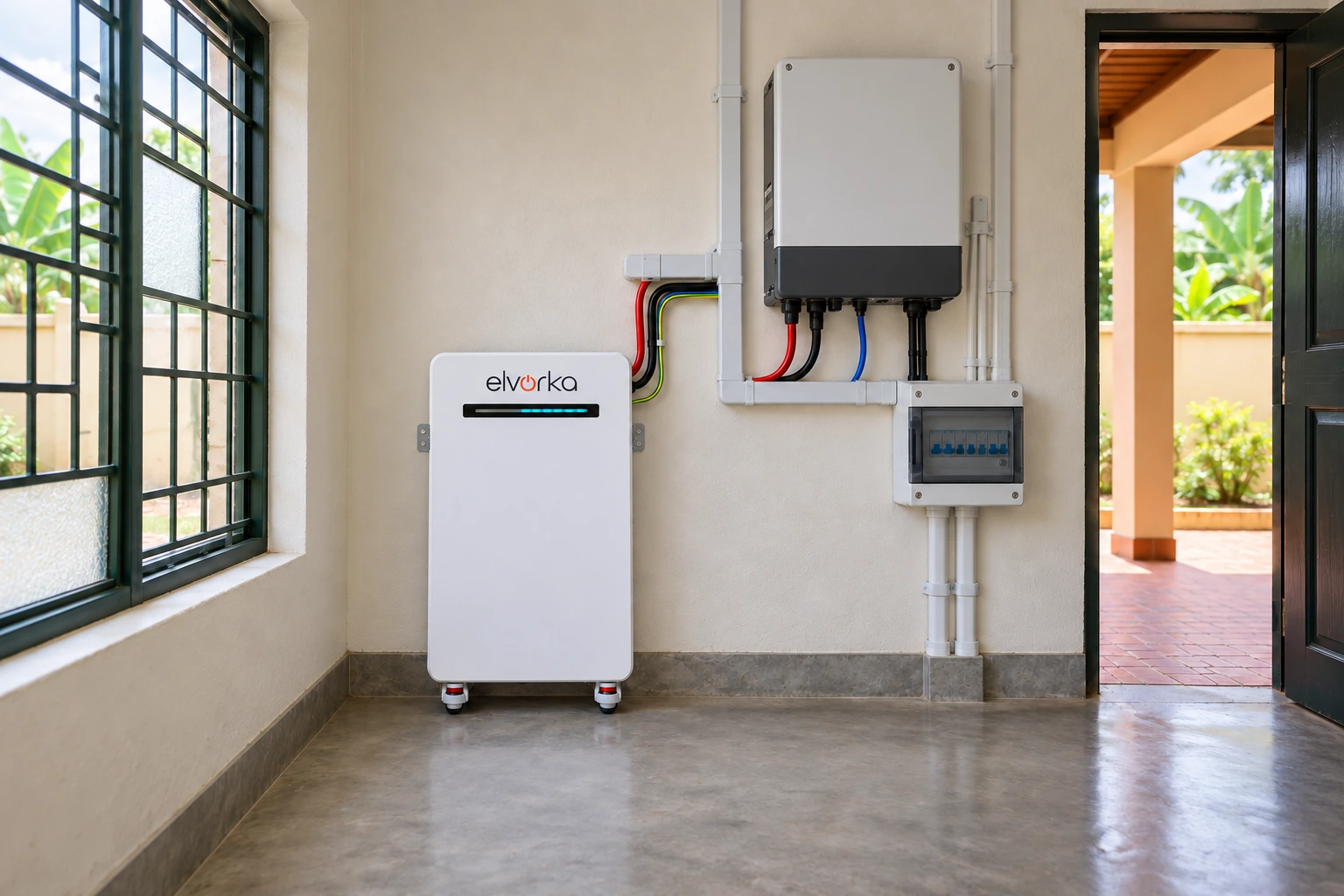
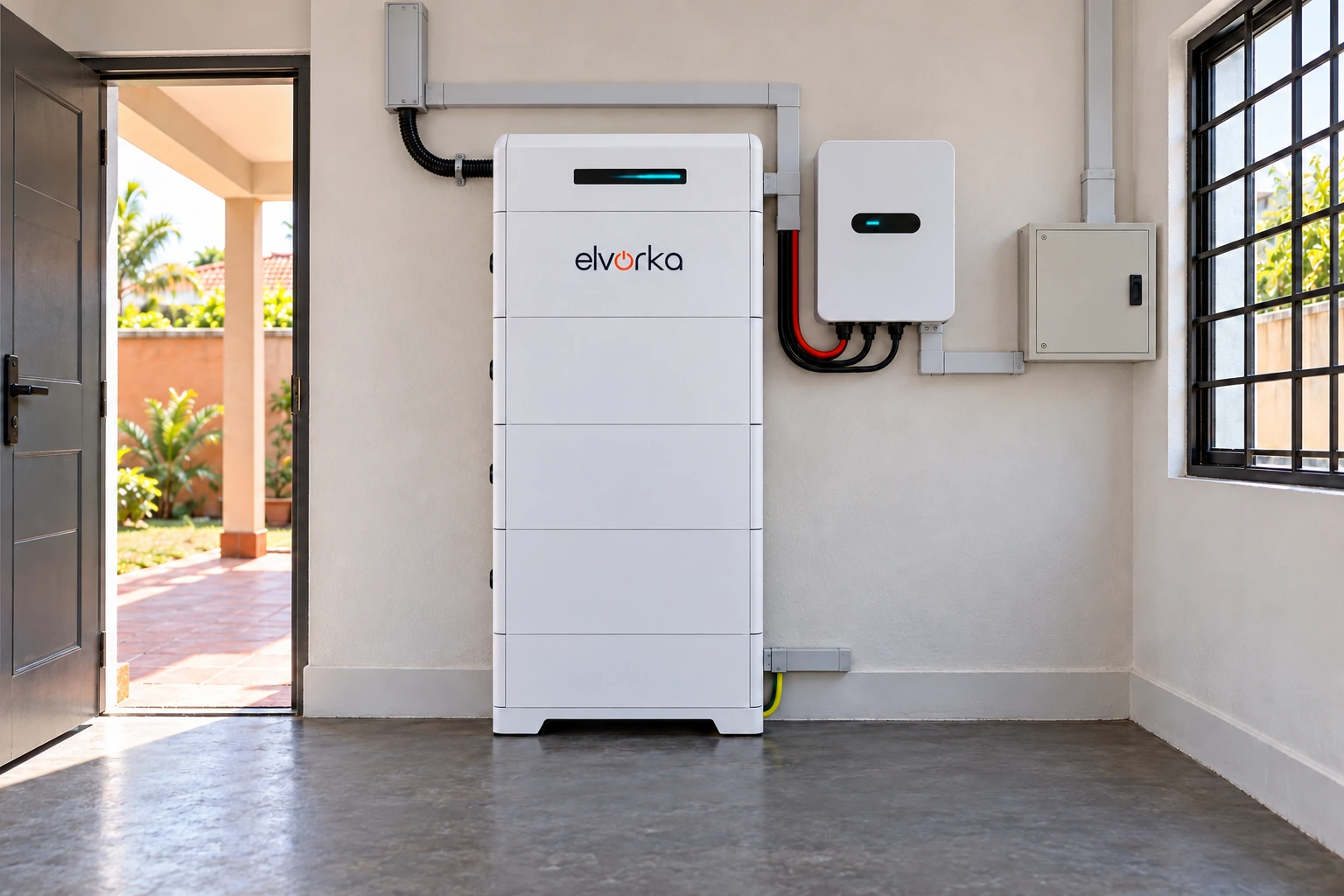
A dry utility room, a seasonally hot garage and a coastal service area place different demands on equipment. Assess conditions where the battery will stand, including the coldest and hottest periods. The following local profiles help frame the questions; they do not certify a particular installation.
Uganda’s rainfall patterns differ by region, with much of the country having two main rainy seasons and additional mid-year rainfall in northern and some eastern areas. Choose useful storage around your home’s tasks and a protected utility space, rather than a single national installation assumption.
Household essentials, planned for a dry dedicated equipment space.
Connected household and home-office essentials
A home-office plan can start with lighting, the router and computing equipment, then add refrigeration or other selected household circuits. A dedicated dry utility room keeps the equipment accessible for service.
EU combines battery and inverter in one system for an indoor IP21 installation. Where an appropriate inverter already exists, a TR Pro 51.2 V battery offers a compact battery-only route with confirmed electrical and communication compatibility.
Questions for your installer
- Which appliances should continue running, and for how many hours?
- Is this a new complete system or an extension of an existing inverter?
Rain-season planning in a sheltered service area
Different rainfall seasons make the actual doorway, wall and floor exposure useful details in the inquiry. A dry service room supports an orderly installation away from household activity and water storage.
Choose the enclosure for the real position. TR Pro and HP Ultra list IP66; EU lists IP21, and standard TR/HP K offer different enclosure options. Plan shelter, fixing, drainage and protected cable routes for the exact model.
Questions for your installer
- Can rain, wash water, a roof leak or standing water reach this equipment?
- Will the installation and its service access remain dry throughout local rainy periods?
More energy with a compatible existing inverter
A household that already has a suitable inverter can plan a larger energy reserve around refrigeration, connectivity and chosen circuits, with capacity selected for the desired duration.
Compare compact low-voltage storage with modular high-voltage storage as distinct options. TR Pro is 51.2 V; HP Ultra requires a compatible high-voltage inverter. Check communication and current limits before choosing capacity or module count.
Questions for your installer
- What are the inverter make, model and supported battery-voltage window?
- Which running and starting loads should the complete system support?
Planning notes
- Plan stored energy in kWh against the required duration and average load. Check inverter AC output, battery limits and motor/compressor starting demand separately before assigning the final essential circuits.
- Use the exact battery’s environmental limits. TR Pro lists charging at 0 to 55 °C and discharging at −20 to 60 °C; EU lists charging at 0 to 55 °C and discharging at −20 to 55 °C. HP Ultra needs configuration-specific temperature confirmation.
- Treat enclosure and shelter together: an IP66 rating does not establish flood, condensation or corrosion suitability. TR standard and HP K list IP20 with IP54 optional, TB rack lists IP20, and EU lists IP21; keep their installation conditions distinct.
Keep charging and discharging limits separate
The TR Pro literature lists charging at 0–55 °C and discharging at −20–60 °C. The colder discharge boundary is not permission to charge below zero. Self-heating is optional and must be confirmed for the exact configuration. HP Ultra temperature limits require configuration confirmation; do not transfer another family's limits to it.
Read the views, then request the exact manual
The technical library retains the original product views and numbered interface labels. A visible connector is not enough to infer a pinout, polarity or power rating. Confirm the selected model's wiring diagram, protection, cable requirements, clearances, torque values and communication settings from its installation documentation. The scene illustrations are visual references, not wiring instructions.
Record the proposed room, expected temperatures, moisture exposure and maintenance access. For an integrated system, confirm the required AC configuration. For a battery-only system, include the existing inverter model and DC voltage range in the brief.
Questions for your installer
Can I plan for my household without relying on an outage schedule?
Yes. Choose the backup hours and essential circuits you want to plan for. The load examples are illustrative assumptions and do not claim current outages, national household consumption or guaranteed runtime.
Does a battery-only installation include an inverter?
The battery-only families require a compatible external inverter; the electrical architecture must be confirmed for the exact combination. EU is an integrated battery-and-inverter system. This collection supplies integrated storage and batteries, not standalone inverters or solar panels.
Can the basic load presets include a pump or electric water heater?
They exclude those loads. Provide the real appliance ratings, operating time and any motor starting demand for a separate design check. More stored energy can extend duration, but it does not automatically raise the system’s AC output or starting capability.